

Healthcare Workspace Design from MAREJ
Our Executive Director of Healthcare Sales, Maria Scenna, is featured in Mid Atlantic Real Estate Journal with a piece that explores the future of healthcare workspace design: where it started, where it stands today, and where it’s headed next. It highlights an important shift in healthcare environments from spaces designed primarily for efficiency and compliance to spaces that also prioritize comfort and better patient experiences.

Healthcare environments have always been shaped by necessity, but today they are being redefined by expectation. Patients expect more comfort. Care teams need more support. Systems demand more efficiency. And the spaces themselves? They’re expected to be more than a place where care happens. They must actively contribute to it.
This evolution is not a series of trends, but a continuous shift toward something more human. It is never just about the space. It is about what happens in it and how it makes people feel, heal and thrive.
To truly understand where healthcare design is today requires looking at where it has been and where it is going to be over the next 5-10 years.
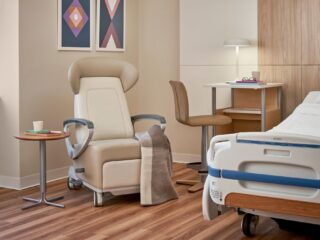
Where We Were: Efficiency, Standards, and the Foundations of Care
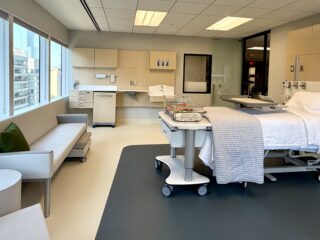
Healthcare design in the early 2000s and into the 2010s was driven primarily by clinical efficiency and operational necessity. Patient-centered care was emerging as a concept, but in practice, environments were still largely built around workflows, reimbursement structures and the logistics of delivering care at scale.
Layouts prioritized proximity and access. Nurse stations were positioned for visibility. Supply storage was integrated into units for speed. Standardized room configurations were designed to optimize turnover and reduce variability. Design decisions were heavily influenced by measurable outcomes, including how quickly a room could be cleaned, how efficiently staff could move, and how effectively systems could support billing and compliance.
Evidence-based design began to gain traction during this period, introducing elements like natural light, improved sightlines and quieter environments. These were important advancements, but they were often built into existing frameworks rather than fundamentally reshaping them.
The industry began to recognize that the environment impacts outcomes, but spaces were still designed primarily for systems, not for the full human experience.
Architects, designers and furniture partners played a critical role, often within defined constraints. The goal was efficiency and compliance versus welcoming or adaptable. So while yes healthcare environments worked, they still were not desirable spaces where people wanted to be.
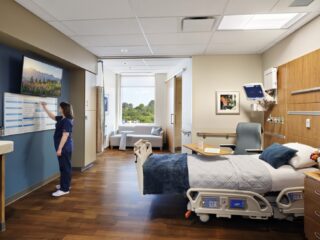
Where We Are Now: Hospitality, Experience, and Human-Centered Design
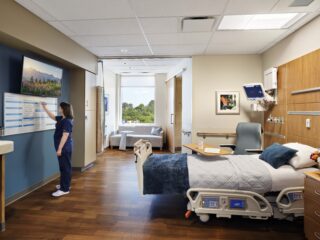
Today, healthcare design has shifted dramatically. Efficiency and clinical performance remain essential, but they are no longer the sole drivers. The industry has embraced a broader understanding of care, one that includes patients, families, caregivers and clinical staff.
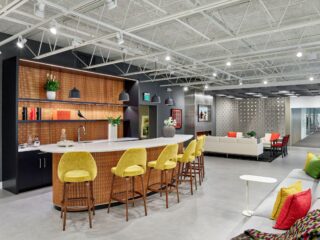
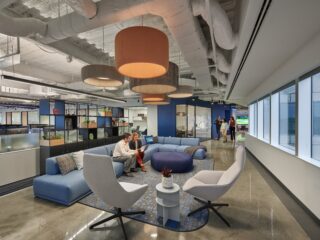
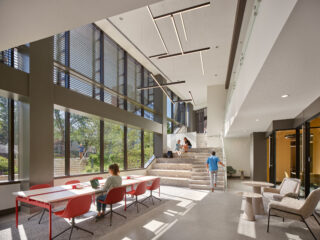
Healthcare environments are now borrowing from hospitality. Biophilic design has taken a larger role where open gathering spaces with softer materials, layered lighting and more intuitive layouts are becoming standard. The goal is no longer just to treat illness. It is to create healing environments that reduce stress, support well-being and feel more familiar and accessible.
Healthcare has become more experience-driven, with greater emphasis on how people move through a space, interact and are supported at every touchpoint.
This shift is visible across a range of design decisions:
• Larger, more open waiting and gathering areas
• Spaces designed for collaboration and connection, not just function
• Increased focus on caregiver experience and workflow support
• Intentional pathways that improve navigation and efficiency
At the same time, operational demands have become more complex. Healthcare systems are under pressure to do more with less. Less space. Fewer staff. Tighter budgets. This has led to a renewed focus on efficiency, but with a different perspective. It is not about minimizing space but optimizing it.
Hybrid care models, outpatient services and decentralized systems are changing how facilities are used. Technology has advanced, but the emphasis is shifting toward simplifying its presence so it feels seamless and less intrusive.
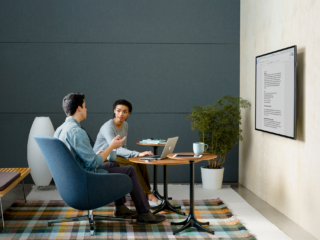
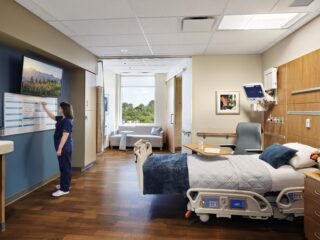
There is also a growing recognition that caregivers need environments designed for them, not just for patients. Respite areas, quieter zones and better workflow support are becoming critical components of modern healthcare design. And these spaces must be in the closest proximity to the patient. Caregivers do not wish to wander out of the treatment areas for respite. This shift reflects a deeper understanding of the people who rely on these spaces every day. Care teams want to remain close to their patients, with easy access to supplies and nearby places to reset. Families share many of those same needs, seeking comfort, clarity and proximity during moments that matter most.
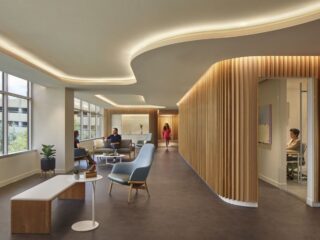
Where We’re Going: Flexibility, Technology + Decentralized Ecosystem
Looking ahead, the next evolution of healthcare design is not about a single trend. It is about adaptability. The industry is moving toward a broader ecosystem, not just a building.
Over the next five to fifteen years, healthcare environments will continue to shift toward more flexible and decentralized models. Facilities will need to respond to changing technologies, shifting patient needs and evolving care delivery methods in real time.
That ecosystem will be:
• Modular and adaptable, allowing spaces to be reconfigured quickly
• Technology-enabled, incorporating AI and real-time data to support decision-making
• Decentralized, with care extending beyond traditional hospital walls
• Multi-use, supporting a range of functions within a single environment
Furniture and interior solutions will play a critical role in this shift. Systems will need to support rapid change by adjusting to different users, different needs and different modes of care without requiring major renovation.
Real-time patient and staff needs will influence how spaces are used moment to moment.
Flexibility will no longer be a feature. It will be a requirement.
There is also a growing emphasis on sustainability, both environmental and operational. Spaces must be designed to last, adapt and evolve without constant reinvestment. Even as technology advances, the need for connection, comfort, and clarity will not change. If anything, it will become more important.
Closing: Designing for What Matters Most
Healthcare design has come a long way, from efficiency-driven environments to experience-centered spaces and now toward adaptable ecosystems built for the future.
At its core, the mission is the same and the human element remains central. It is about creating spaces where people can do their best work and where others can receive the care they need.
That is where CFI Workspace continues to focus its efforts, bringing together insight, experience and a deep understanding of healthcare operations – one that supports environments which are flexible, purposeful and built to evolve. By working closely with partners across design, construction and care delivery, CFI views its role as one far beyond just furnishing spaces. It is to help shape environments that truly support the people within them.